Zoro Feigl

Installation artist Zoro Feigl is collaborating with TU Delft researchers from the Aerospace department to realise an ambitious project: Glider.
Glider
A dance of visible and invisible forces that are needed to control the ephemeral. A high-tech child’s play flows through the space with heavy-duty industrial machinery.
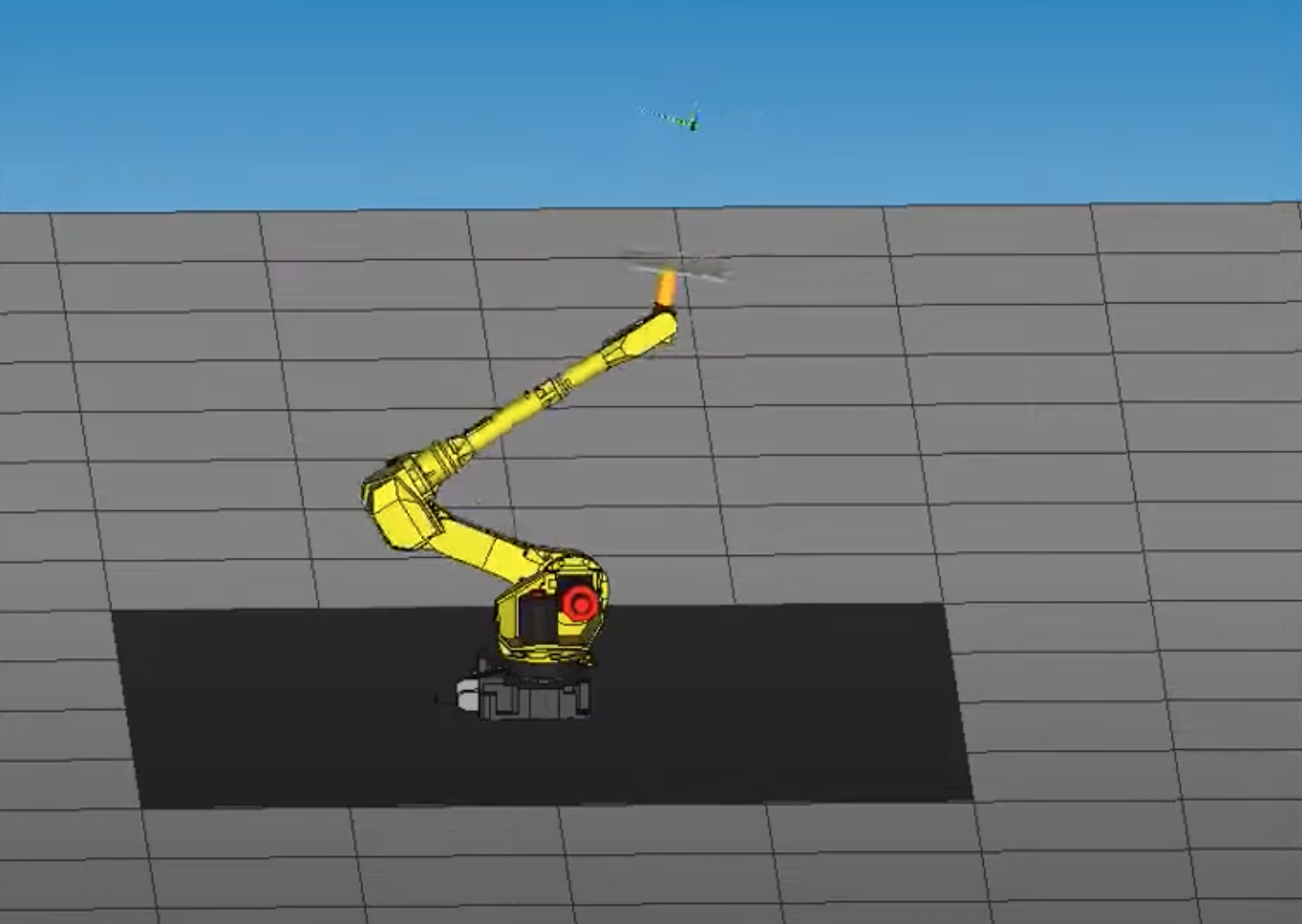
An industrial robot arm moves its limb elegantly high above the viewer. The gentle machine thrusts a paper plane on an invisible air wave generated by its movements. The robot senses the plane's position and continually adjusts the wave it creates to maintain the plane's airborne state. There are no strings involved; the paper plane literally surfs on a wave of air generated by the movement of a paddleboard through the air.
The sculpture consists of a small paper plane and a robot arm. This type of paper plane is known as a walkalong glider or controlled-slope soaring plane. The plane ‘surfs’ on an airwave made by a small ‘paddle’ attached to the robot arm. The airwave is made by the movements of an industrial robot arm with a transparent board. The robot contains sensors that measure the location, angle, and velocity of the plane, to constantly adjust its movement to that of the plane and keep it in the air. The goal is to control the robot arm so that different choreographies or flight paths are generated, allowing the paper plane to keep flying indefinitely.
The project is ambitious for both the artist and scientists, because the model for the interaction between the paddle and the plane needs to be developed based on experimental data. Together, they still need to puzzle out which data is needed to control the plane and which interpretations are needed to keep it in flight. From then on, a choreography or flightpath will be able to emerge based on 3 factors: the scope of the robot joint mobility and its reach, the flight dynamics of the glider plane, and the turbulence from outside factors.
Profiles
Zoro Feigl
Zoro Feigl (1983, Amsterdam) is an installation artist based in Amsterdam (NL)and Ghent (BE). He graduated from the Rietveld Academie, Amsterdam and the Hoger Instituut voor Schone Kunst, Gent. His work has been shown internationally at various exhibitions including the Mori Art Museum Tokyo, SPACE Pittsburgh USA, KisArt Busan Korea, National Art Museum of China, Galeria de Arte do SESI Sao Paulo, Arti et Amicitea and Fons Welters. His works is in international museum collections such as HeART museum Herning Denmark, Stedelijk Museum Schiedam, Rijksmuseum Twenthe Enschede, Museum Voorlinden Wassenaar and the Verbeke Foundation Belgium and has made several commissions for public space such as the work ECHO for the Ministry building in The Hague and Rock&Roll for the National Archive in Emmen, NL. He won the Volkskrant Beeldende Kunst publieksprijs 2013, and the Witteveen+Bos Kunst+Techniek Prijs 2018 and has been nominated for Dutch Artist of the year continuously since 2021.
Feigl’s forms are constantly changing, sometimes slowly, sometimes quickly. The exhibition space becomes an enlarged microscope: single-cell creatures, primitive organisms are twisting, groaning and convulsing. Without beginning or end the objects seem to be locked into themselves. As a viewer you become entangled in their movements: they embrace and amaze, but sometimes also frighten you.