Aldo Brinkhoff

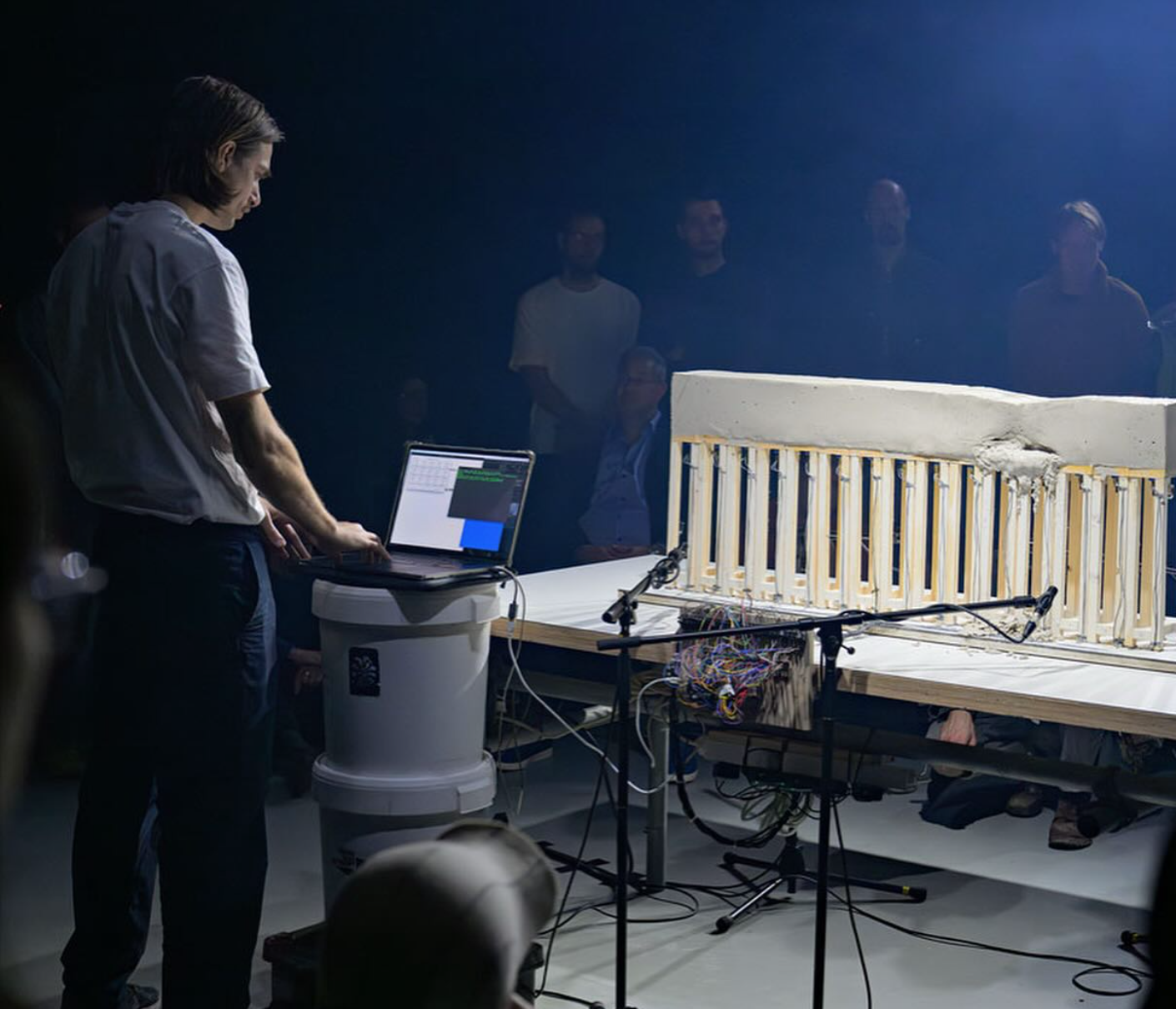
Aldo Brinkhoff presents a miniature version of Thixocymatics during Obviously Unthinkable: Matter Rebellion at iii.
Thixocymatics
Thixocymatics is a kinetic sculpture that explores the interaction between vibration, matter, and transformation. The piece is based on the behaviour of thixotropic materials — substances whose viscosity changes over time — and draws from the principles of cymatics, the study of how vibrations generate patterns.
Thixotropic materials have a time-dependent viscosity; they behave as solids until agitated, then briefly turn liquid before returning to a solid state when the stressors are removed. Meanwhile, cymatics studies how vibration creates patterns, typically using liquid surfaces. Thixocymatics combines these principles to generate patterns not on a flat plane, but within a three-dimensional space.
Using tools from the world of construction, particularly concrete formwork, the piece builds a choreography with thixotropic calcium. The material resists stability, continuously reshaping itself into an evolving, unstable landscape. Through this perpetual flux, Thixocymatics embodies a delicate balance between order and collapse, control and emergence, structure and fluid transformation.
This project was made possible with support from Amarte, TU Delft, iii, and the Cultuurfonds. It was carried out in collaboration with associate professor Eduardo Mendes, whose research at TU Delft focuses on Functional Soft Matter.
Resident
Aldo Brinkhoff
Aldo Brinkhoff is a kinetic artist who works with an intuitive approach to chemistry to explore, isolate, and amplify natural phenomena. Fascinated by the uncontrollable and transformative nature of chemical processes, he navigates their complexity to create systems that give rise to transient spatial experiences. By combining principles of chemistry with scenographic composition, Aldo constructs environments that are in constant motion: alive, responsive, and unpredictable.
Eduardo Mendes
Eduardo Mendes' research focuses on "Functional Soft Matter” and encompasses fundamental and application aspects. Mainly working with gels and self-assembled molecules, he uses micro-fabrication, microfluidics, and 3D printing techniques to formulate new responsive, functional, soft materials. Studies span from light-responsive microstructured surfaces to drug nanocarriers, tissue engineering, and lab-on-a-chip virus detection.
Eduardo Mendes has a background in physics and received a PhD in France on polymer gels. After a few years at Ecole de Physique et de Chimie Industrielles de la Ville de Paris (ParisTech) as a CNRS fellow, he moved to the ‘Laboratoire des Fluides Complexes’ at Strasbourg University. He has been at TU Delft since 2003, where he holds an Associate Professor position. In 2014, he taught at Cornell University as a visiting professor.